
The Soundtrack to the Egyptian Revolution
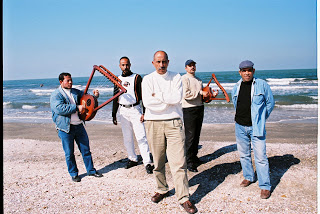
“Egypt is like a big sister to the other Arab countries. It’s easy to see from our history whyEgypt has become so important.” Zakaria Ibrahim, front man for the Egyptian folk band El Tanbura, cuts a humble figure considering his achievements. Credited with providing the soundtrack to the Egyptian revolution, his generation spanning crew of singers, dancers, fisherman and philosophers have come along way from their Suhbagiyya playing days inPort Said. I caught up with him backstage after El Tanbura’s lunchtime slot at Womad Festival.
“Our resistance songs grew out of the war in 1956, when three countries attacked Port Said after we nationalised the Suez Canal- Britain, France and Israel. We resisted very well. In fact, we succeeded to win by some way. At that time the future of all Egyptian people was dependant on the war, and so everyone became interested in our resistance music. Our music style is called Suhbagiyya. It’s a style that’s unique to Port Said, notEgypt as a whole. In Cairo for example, their only exposure to Suhbagiyya was through us.”
“Fifty years later we sung the same resistance songs in Tahrir Square during the Egyptian revolution. We updated some songs to make them relevant to the revolution, and we sung them from one week before it started to the step down of Mubarek. Every day we made about five performances on different stages. In the final few days in the square, the audience had grown to over a million people.”
And all this from a bright eyed, little old man in a flat cap. I got the feeling that the Womad set was play time for El Tanbura- no political motivation, just Suhbagiyya music and dancing. The crowd were appreciative, whooping enthusiastically in between mouthfuls of exotic festival food. I ask him about El Tanbura’s new status as national heroes.
“To some we’re heroes, but we’ve also been accused of using the revolution to boost our popularity and take what Egypt achieved away from the people on the street. In truth, we were national heroes before the revolution. Ever since the Port Said invasion we’ve fought to maintain our national pride, so Egyptians have long seen us as an inspirational group. Many tell us that we inspired them to take part in the revolution.”
“The power of people is amazing- nineteen million protested in a single day against Mubarek. I am very optimistic about the future of Egypt and the Arab world now that our people have freedom. There are many things to set right still, but we have made a big step. Throughout all the Arab countries there is co operation thanks to online social media, between people from Tunisia, Yemen, Syria and Egypt; everywhere people are talking. Not so much in Iran because there is a language barrier, but certainly among Arabic speakers. Things are moving along quickly through this ease in communication, and we are encouraging each other to speak our minds.”
Ibrahim proudly told me about his latest project, the El Mastaba Centre for Egyptian Folk Music.
“It’s fantastic to see our music being enjoyed by a younger generation. In 2003 I opened the school, and some of the ex-students are now members of El Tanbura. We are a big group. This is half; in full we are about 20. We have also been particularly successful in promoting two groups in addition to El Tanbura- a rango group (rango music was introduced to Egypt by South Sudanese slaves in the early 19th century) and the Bedouin Jerry Can Band. Things are developing well.”
 I'm Clyde Macfarlane, an NCTJ qualified journalist and illustrator.
Leave a comment