

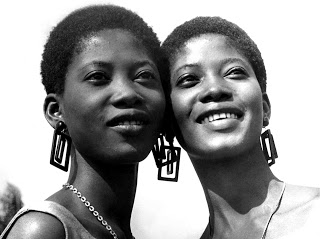
Interview with The Lijadu Sisters
Most women in afrobeat fit into two well established roles: erotic dancers or backing singers. In the former they are sex objects, in the latter they are background figures by definition. Fela Kuti, the man with 27 wives, would parade his “queens” around on stage like a farmer showing off his cattle. This is exactly why the Lijadu Sisters, second cousins to the legendary Fela, were such an anomaly for Nigerian music.
The twins grew up in Jos, a volatile region between Nigeria’s Islamic north and Christian south. From a young age they were song writing- Kehinde when she was 10, Taiwo when she was 17- and, like many Nigerians with a passion for afrobeat, they started their musical careers as backing singers. Their subsequent path to fame was reliant on industry superiors who “didn’t think women had brains”. This, the twins believed, was an attitude that went beyond Nigeria.
“Men all over the world at that time seemed to think women were just glorified trophies. They didn’t think we had feelings or were capable of expressing ourselves. They didn’t think we were capable of communicating to the ‘powers that be’ for the good of mankind, not only in Nigeria but to the world at large.”
So how does a female singer become a star in their own right? “For us it was easy. We have a musical background from both our maternal and paternal family, and our late mother always encouraged us to go for a musical career.” Taiwo and Kehinde remember a special fondness for Aretha Franklin, Miriam Makeba and Ray Charles records throughout their childhood. Whilst Makeba was undoubtedly preoccupied with Apartheid, Franklin’s plight for “respect” from men clearly had an influence for the twins in later life.
“As we sung on our third record [Sunshine], we have to “stay and fight for our rights until we win; our destiny is not in your hands.” We have equal rights as women to choose our profession and our destiny in life.”
Danger, the Lijadu Sisters’ debut record, has a more subtle message of social and political awareness, with the title track addressing these themes through metaphor and allusion. On the surface the twins warn of a “dangerous lover”, yet in a wider context this is a reference to Nigeria’s political instability. The threat of the government was something to be taken very seriously; the not so disguised message of Fela Kuti’s Zombie, also released in 1976, led to a one thousand soldier attack on his proclaimed Kalakuta Republic and the murder of his mother.
Taiwo and Kehinde were lucky to have regular assistance from Biddy Wright, one ofNigeria’s great multi-instrumentalists. On Danger, Buddy’s co-arrangement gives a slow, sultry pace to Amebo, and an even slower pace to Life’s Gone Down Low. The album is a very listenable piece of afrobeat- clearly not made to challenge the huge popularity ofZombie, but impressionable in its own right. And, all importantly, the Lijadu Sisters’ perfectly harmonised vocals take centre stage.
“We’ve made it easier for Nigerian female artists,” the twins say with confidence. “We took no nonsense from the recording agencies, promoters and journalists. Most importantly, we respected ourselves. We spoke and sang about social justice for everybody, with an emphasis on fairness for all.”

 I'm Clyde Macfarlane, an NCTJ qualified journalist and illustrator.
Leave a comment