
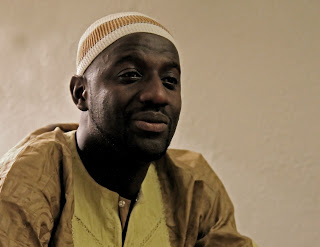
Interview with Seckou Keita
“A lot of people ask that question!” Laughs Seckou Keita. I’ve brought up the subject ofSalif Keita.
“It’s a long distance relation, but all the Keita’s are descended from a ruler in the 13thcentury called Sundiata Keita. He was a king who ruled over eleven countries in West Africa under the Mandinka Empire. If you’re name is Keita, there will be a link somehow- if we want to talk about it we might have to do weeks and months of research though! TheCissokho’s are on my mothers side, and this is very recent. The path I know better is from my mother’s father and her brothers. I grew up with them learning the kora and the griot oral tradition, so the social role I have adopted is from my mother’s side.
Photograph by Alexander Macfarlane
People often hear my name and think: a kora player named Keita? How come? Normally Keita’s are not allowed to play the kora; they receive entertainment, they do not give entertainment. Salif Keita has Keita’s on his mother’s and father’s side, so his role as a singer is extremely unusual. This is the tradition in Senegal that dates back to the 13thcentury. Even though there aren’t kings around anymore, the old social roles are still apparent.
Because I grew up with my mother, it was important from an early age for me to learn how to build and play the kora. Casamance is an amazing part of Senegal. It’s a melting pot of people. Having such a large number of ethnical groups has an influence in the culture, art and music, and this is where I was lucky enough to grow up.
My reason for leaving the house was to play music. The Keita ancestry is there, but how am I going to use it practically? For me, oral tradition is essential to every day living. This is why my ancestors have kept it alive in the past. We learn the structure, we follow the structure, and then we grow to an age when we can deliver what we have seen and observed of our own times.
You can see how griots played a very important role in West Africa in the early days. They were the intermediates between the king and the village people, so my music is just the latest chapter in this long history. My compositions are still traditional- if you have been trained traditionally, you can’t escape it. It’s my foundation, my basement. The first and the second songs of my sets are always traditional; then I can start playing my own material.”
 I'm Clyde Macfarlane, an NCTJ qualified journalist and illustrator.
Leave a comment