
Interview with Muntu Valdo
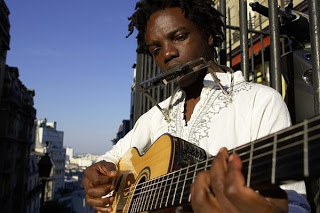
“My music is commonly known as sawa blues,” says Muntu after some thought. “A lot of people gave it that name, and in time I started using it.” On stage at last weekend’s Larmer Tree Festival, he embraces this grassroots attitude. Things seem to happen naturally around him. He arrives late, apologises, and does a sound check with various members of the audience. Amidst the slow start a blonde, bearish man becomes the unaware spearhead for a nap circle; nobody seems to mind. When a rain shower hammers on the roof of the tent Muntu slips into an a cappella style, tapping his fingers on the body of his guitar in an improvised patter.
“Journalists would listen to me play and want to write about it, but then become faced with this problem of categorisation. I think in my case, a lot of confusion developed because my music is very distinct from makossa. Makossa is the most popular kind of music inCameroon”
“You may have heard of a man called Manu Dibango?” he asks, singing a familiar snippet:“mama-say, mama-sah, ma-ma-koo-sah!” Dibango’s chant was popularised by Michael Jackson on Wanna Be Startin’ Somethin’, and his adaptions spawned many other uses.
“…so people were saying: “you’re not playing makossa, and you’re not playing the music we know generally from Central or West Africa with a dominant percussion… but your music sounds bluesy and jazzy”. It’s actually just the music from where I’m from in Cameroon. They said: “We can’t call it blues, because it’s not the blues we’re used to hearing from America or Mali.”
It was that year- 2003, I think- when Martin Scorsese released Feels Like Going Home, which linked the Mississippi Delta to Mali. With that you had Ali Farka Touré (Valdo used to play with Farka Touré in Paris), who christened the name desert blues. So although my music sounds like blues, it’s from somewhere completely different.
“Where are you from?” they would ask. And then, “but where in Cameroon?”
“I’m form the Sawa region,” I would respond.
“So can we call your music sawa blues?”
“Why not!”
So people started to call my music sawa blues.
Is there a particular area or genre in America that you associate with?
If someone comes to my country and to the river area, and the villages around the river, they will hear recognisable music. You just have to replace the language, it’s all the same. In America you used to have work songs- for example, when slaves were in the cotton fields- in Cameroon these songs are still alive. It’s not the work songs from slaves, but it can be a work song for women who wash their clothes in the river, or when people go out and farm. There are too many kinds of music to name, but ngoso, esewe and dutu are very similar to American work songs and my own music. Now with our knowledge of history we can see how slaves from all over Africa kept their culture. But I do strongly believe the word blues was born in America. Sawa does sound a bit bluesy- ‘work blues’, I like to think- and I can understand why journalists have called it blues; I’m proud to have initiated that.
Do you address political issues in your music?
I’m not just here to entertain. I like to think I reflect the opinions of society. It could be politics, or it could be just a reflection of what I observe in daily life. I can praise good things and criticise bad things, hence you have political themes in my songs. With the growth of social media in Cameroon, young people see my as an example to follow. In makossa music you rarely have a serious theme, it’s just to make people dance. It’s not just me- there are a few people in Cameroon who can use music as a political vehicle- but moving away from makossa definitely makes this easier. I met a great musician in Camerooncalled Eko Roosevelt, and I used to play a lot with him.
And the new album?
The new album is already out. It was released by Warner Jazz, and it’s called The One And The Many. The set today was all songs from that album. I’ve had a lot of good personal feedback through social media- I value those opinions very much. Ordinary people seem to like the album and the concept.
So is there much experimentation with a cappella music on the album?
On the album I actually only did one a cappella song. I did recently tour with Ladysmith Black Mambazo, who had about 30 dates in the UK. I always did two songs with them at the end of the show, and I used this opportunity to try out my a cappella songs. Music is music; it can be great without instruments. The voice is an extremely powerful instrument. It doesn’t matter about the complexity of the instrument, or the number of people in a band. If there’s talent, the music is going to sound good.
 I'm Clyde Macfarlane, an NCTJ qualified journalist and illustrator.
Leave a comment