

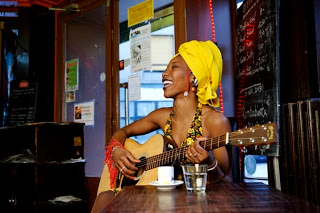
Interview with Fatoumata Diawara
Hailed as Africa’s best interpretation of the ‘girl with a guitar’ archetype, Fatoumata Diawara is the latest Malian to be signed by World Circuit, the label that provided a platform for such legends as Toumani Diabaté and Ali Farka Touré. While these two were very much Malian exports, Diawara holds a closer tie to Europe.
“Now I compose all my songs with a guitar instead of a kamalen n’goni (a six stringed harp)”, she tells me. “This was a big change for me.” Compare this attitude with the climax of World Circuit’s Malian ventures- Diabaté and Farka Touré’s formidable In the Heart of the Moon– and we have an artist who comes closer to acoustic folk than traditional African music. Despite singing in Wassoulou she seems to play down her African identity, choosing instead to cite Paris as her main source of inspiration.
“It’s an amazing place; you can listen to genuine, authentic music from all over Africa, but you can also listen to more modern styles that you cannot find in Mali or Senegal.”
This microcosm of cultures does not, however, swamp over the spacious elements that make Fatou a great acoustic album. The minimal guitar and percussion style of the opening track prevails throughout. Diawara’s passionate, emotionally charged vocals hold the kind of strength that lives up to her inevitable Tracy Chapman comparisons; like Chapman, Diawara is an important female voice in a society controlled by men.
Unlike Chapman Diawara’s themes are obstructed by a language barrier, and this is at the heart of why she fills such a niche for World Circuit. It would be disrespectful to enjoy her music and not research into these themes: a woman’s right to choose her marriage partner on Bissa, the controversial subject of female circumcision on Boloco and the common African practise of giving children to be raised by others on Sowa. The sounds of the words have an aesthetic beauty, and by singing in Wassoulou Diawara brings exoticism to this simple yet powerful form of protest music. She tells of how she came to realise her potential:
“When I started to sing with a guitar in Paris, people instantly recognised my voice as African. I tried to disguise my accent, but they could always tell. Ironically, this worked in my favour. Many people invited me into their projects to give an African influence by singing Wassoulou lines.”
“And why Mali?” I ask, curious as to why the country boasts such a wealth of musical talent.
“Mali will never give up its tradition,” she says with proud smile. “We have our unique instruments that have remained unchanged for many years. The climate is harsh, and it can be hard for other influences to come in. The result is that in every village the music is different. Every region has its style and now we can mix these in making new music; it’s no problem.”

 I'm Clyde Macfarlane, an NCTJ qualified journalist and illustrator.
Leave a comment